
Psychometric Assessment vs DMIT: What’s the Difference?
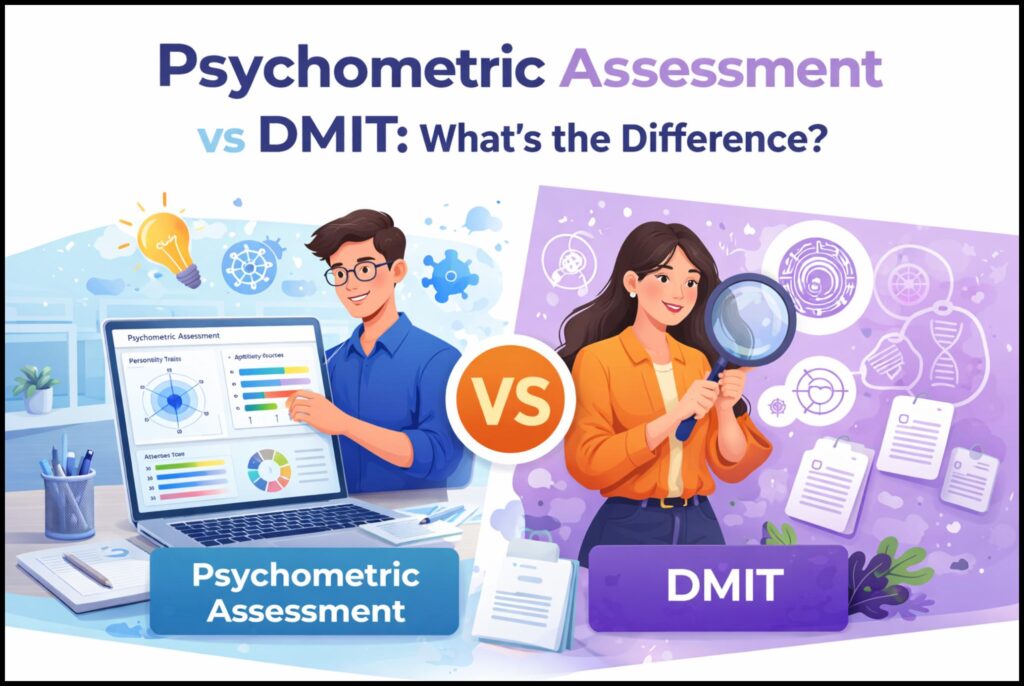
Portfolio Psychometric Assessment vs DMIT: What’s the Difference? Understand how psychometric profiling and DMIT analysis differ, and when each assessment is useful for stream and career decisions. Services Career Counselling Topic/Focus Understanding Psychometric vs DMIT Author Prof. (Dr.) Chetan Kapadnis Making Sense of Career Assessment Claims Choosing the right career or academic stream can be one of the most important decisions in a person’s life. With numerous tools and assessment methods available, two approaches often discussed are Psychometric Assessments and Dermatoglyphics Multiple Intelligence Test (DMIT). While both aim to provide insights into an individual’s abilities and preferences, they are based on very different assumptions, methodologies, and outcomes. In this guide, we’ll break down what each assessment involves, how they differ from each other, and when to use them effectively for stream and career decisions. What Is a Psychometric Assessment? Psychometric assessments are scientifically developed tools that measure psychological attributes such as: Personality traits Aptitudes Motivations Cognitive abilities Interest inventories These assessments are grounded in decades of research in psychology and are widely used in educational and career counselling, organizational hiring, leadership development, and talent management. Core Features: Based on standardized psychological models (e.g., Big Five personality traits). Uses validated questionnaires and scoring systems. Produces reliable, norm-referenced results. Links directly to behavioural tendencies, learning styles, and occupational match. Typical Uses:✔ Understanding personality strengths and challenges✔ Identifying cognitive strengths (e.g., logical reasoning, verbal ability)✔ Career guidance and stream selection✔ Team fit and leadership potential What Is DMIT (Dermatoglyphics Multiple Intelligence Test)? DMIT (Dermatoglyphics Multiple Intelligence Test) claims to analyse fingerprints and relate ridge patterns to cognitive preferences and intellectual strengths. The idea is that fingerprint patterns — formed before birth — correlate with brain development and multiple intelligences. Unlike psychometrics, DMIT’s scientific basis is not supported by mainstream neuroscience or psychometric research. Core Features: Uses fingerprints to interpret learning styles and intelligence types. Claims to map 8–10 kinds of “intelligences” (e.g., linguistic, logical, spatial). Often marketed for children’s learning guidance. Typical Uses:✔ Identifying preferred learning modalities✔ Suggesting career or subject interests based on fingerprint analysis Countries Trust Psychometric Assessments 0 + Fingerprint pattern analysis Multiple intelligence mapping Learning style identification Brain dominance interpretation Inborn potential profiling Career inclination suggestions Psychometric Assessment vs DMIT: Key Differences Aspect Psychometric Assessment DMIT Scientific Foundation Strong psychological research base Not scientifically validated Methodology Questionnaires & task-based measures Fingerprint pattern interpretation Outcome Validity High reliability & consistency Questionable academic support Use in Counselling Widely accepted in career guidance Often supplementary or promotional Best For Deep self-awareness, career alignment Learning style exploration (interpretive) Which One Should You Choose? When to Use Psychometric Assessments If your goal is to: Make informed career or academic stream decisions Understand personality and aptitude objectively Explore careers aligned with cognitive strengths Then psychometric assessment is the ideal choice. It offers research-validated insights and practical applicability for decision-making. When to Consider DMIT If you want: A creative starting point to think about learning preferences Non-traditional or engaging ways to introduce self-discovery DMIT may be used as a complementary tool — not the sole basis for serious career decisions. In Summary Psychometric Assessments and DMIT both aim to help individuals understand themselves better, but they differ fundamentally in how they operate and the strength of their conclusions. Psychometric assessments = research-based, reliable, decision-oriented DMIT = interpretive, exploratory, not scientifically validated For decisions that matter — like choosing a stream or career path — it’s best to start with psychometric profiling and use any additional insights (like DMIT) thoughtfully and provisionally. Years of Scientific Research 0 + Read our latest insights & blogs All Posts Elegant Portfolio How to Craft Engaging Content for Instagram PortfolioDr. Chetan Kapadnis Social Media Myths You Needto Ignore PortfolioDr. Chetan Kapadnis Social Media Myths You Needto Ignore PortfolioDr. Chetan Kapadnis Subscribe Newsletter
How to Choose the Right Stream After 10th Standard
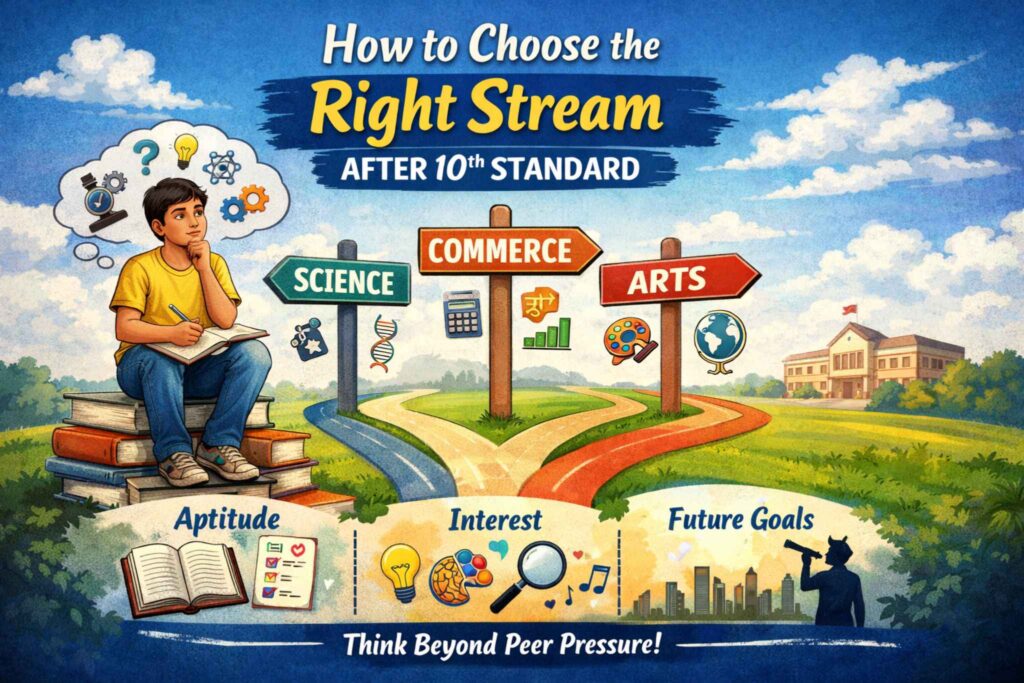
Portfolio How to Choose the Right Stream After 10th Standard A structured approach to selecting Science, Commerce, or Arts based on aptitude, interest, and long-term direction – not peer pressure. Services Stream Selection Topic/Focus Stream Selection After 10th Author Prof. (Dr.) Chetan Kapadnis The First Big Academic Decision Turning the page from 10th standard to higher secondary education is one of the first major academic decisions in a student’s life. It feels heavy because this choice begins shaping future careers, opportunities, and identity. Yet, many students choose streams based on what friends are taking, what seems “tough” or “easy,” or what parents vaguely suggest. This blog brings clarity. It offers a structured, reflective, and actionable framework to help students and parents arrive at a confident and well-aligned decision: Science, Commerce, or Arts. The goal? A choice grounded in aptitude, genuine interest, and long-term purpose rather than pressure or trend. Why This Decision Matters Choosing a stream isn’t just picking subject combinations for the next two years — it’s about: Aligning with strengths rather than weaknesses Fueling curiosity instead of obligation Building a foundation for future career paths Reducing uncertainty and anxiety around the next academic step The right choice increases engagement, improves performance, and makes learning more enjoyable. Step 1: Understand the Options Before choosing, it’s essential to know what each stream broadly offers: 🔬 Science Ideal for students who enjoy analytical thinking, experiments, problem-solving, and technical subjects.Typical Subjects: Physics, Chemistry, Mathematics/BiologyFuture Areas: Engineering, Medicine, Research, Data Science, Architecture 📊 Commerce Suited for those interested in business, markets, money-management, and organization.Typical Subjects: Accountancy, Business Studies, Economics, MathematicsFuture Areas: Finance, CA/CS/CFA, Marketing, Entrepreneurship 🎨 Arts / Humanities Best for creative minds and those passionate about people, culture, language, and expression.Typical Subjects: History, Psychology, Geography, Political Science, LiteratureFuture Areas: Design, Media, Law, Social Services, Psychology, Public Policy Career Paths Across 3 Streams 0 + Sci, Commerce, Arts Overview Core Subject Combinations Required Skills & Aptitude Linked Career Pathways Higher Education Opportunities Stream Myths Debunked Your partners in designing engaging, high-impact brand experiences We collaborate closely with brands to design engaging, high- impact experiences that resonate with audiences and drive results. By combining creativity, strategy, and innovation, we craft memorable visual identities, compelling messaging, and cohesive digital experiences. Every project is carefully tailored to elevate brand presence, strengthen connections, and deliver meaningful, measurable impact that sets your business apart in today’s competitive marketplace. Project Success Rate 0 % Inspiration gathering Concept development Creative strategy Testing & quality assurance Post-launch support Concept development Read our latest insights & blogs All Posts Elegant Portfolio How to Choose the Right Stream After 10th Standard PortfolioDr. Chetan Kapadnis Social Media Myths You Needto Ignore PortfolioDr. Chetan Kapadnis Social Media Myths You Needto Ignore PortfolioDr. Chetan Kapadnis Subscribe Newsletter
Understanding Multiple Intelligence in Children
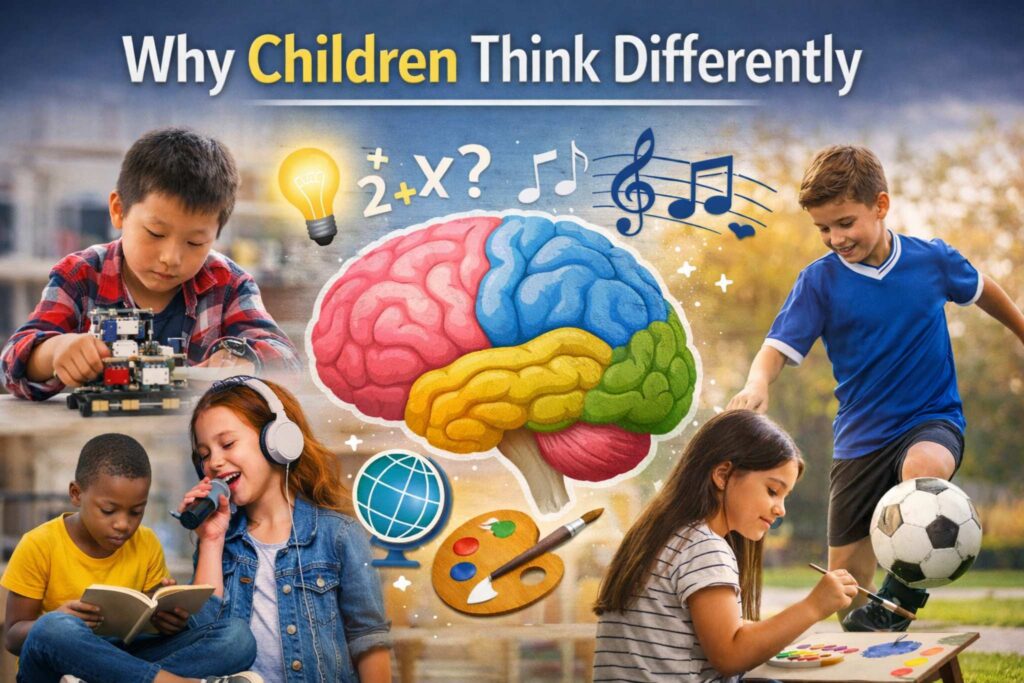
Portfolio Understanding Multiple Intelligence in Children Discover how multiple intelligence shapes learning styles, strengths, and confidence, helping parents guide children toward meaningful academic and career paths. Services Learning Intelligence Types Topic/Focus Understanding Multiple Intelligence Theory Author Dr. Chetan Kapadnis Not Every Child Learns the Same Way Children often get labelled as “good” or “weak” in studies based on traditional academic performance. But intelligence is much broader than marks in mathematics or language. Many children who struggle in conventional classrooms may possess exceptional abilities in creativity, music, leadership, sports, or problem-solving. The concept of Multiple Intelligence explains that every child has a unique combination of abilities. When educators and parents recognize these differences, learning becomes more engaging, confidence improves, and children begin to see their own strengths more clearly. What is Multiple Intelligence? Multiple Intelligence is a theory proposed by psychologist Howard Gardner that challenges the traditional belief that intelligence is a single ability measured only through IQ tests or academic performance. According to this theory, human intelligence is diverse and multifaceted. Gardner suggested that individuals possess different types of intelligence that shape how they understand the world, process information, and approach learning. These intelligences influence the way people think, communicate, create, and solve problems in everyday life. Rather than assuming that all children learn best through the same methods, the theory highlights that every individual has a unique combination of strengths. Some may excel in logical reasoning or language, while others may show strong abilities in music, art, physical movement, social interaction, or understanding nature. Recognizing these different intelligences helps educators and parents support children in ways that align with their natural abilities, making learning more engaging, effective, and confidence-building. Different Ways Children Learn Every child processes information differently, and this difference plays an important role in how effectively they understand and remember concepts. Some children grasp ideas quickly through visual aids such as diagrams, charts, or images, while others learn better through hands-on activities and movement. A few students may respond strongly to music or rhythm, whereas others prefer logical reasoning, problem-solving, or structured explanations. Social interaction also plays a key role for many learners, as discussing ideas with peers or working in groups helps them clarify and strengthen their understanding. The concept of Multiple Intelligence helps identify these natural learning preferences and highlights that there is no single “correct” way to learn. When educators and parents recognize these differences, teaching methods can be adapted to match a child’s strengths and interests. This approach not only improves learning outcomes but also builds confidence and motivation. In the context of career guidance, understanding how a child learns can provide valuable insights into their potential strengths, helping them explore academic pathways and career options that align with their natural abilities rather than forcing them into a one-size-fits-all learning model. Students Hidden Learning Strengths 0 % Logical Thinking Language Skills Musical Ability Visual Creativity Body Movement Social Awareness Read our latest insights & blogs All Posts Elegant Portfolio How to Choose the Right Stream After 10th Standard PortfolioDr. Chetan Kapadnis Understanding Multiple Intelligence in Children PortfolioDr. Chetan Kapadnis Social Media Myths You Needto Ignore PortfolioDr. Chetan Kapadnis Subscribe Newsletter
How Psychometric Tests Help Students Choose Right Career
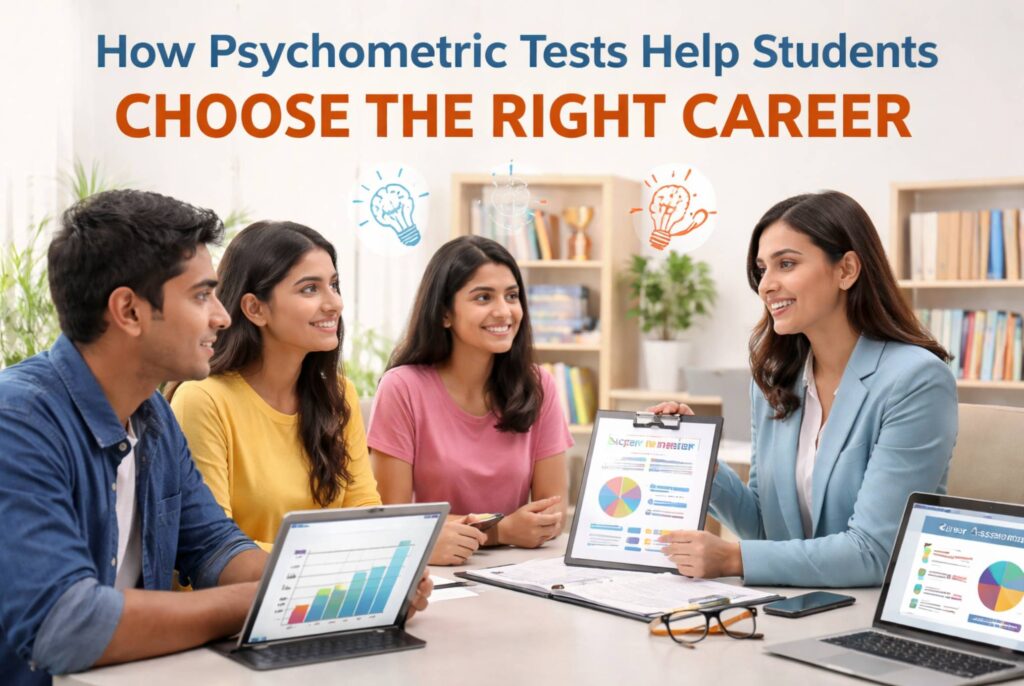
Portfolio How Psychometric Tests Help Students Choose Right Career Psychometric assessments help students understand aptitude, interests, and personality traits, enabling more informed and confident career and stream decisions. Services Psychometric Career Guidance Topic/Focus Scientific Career Decision Making Author Dr. Chetan Kapadnis Stop Guessing Your Career Future Choosing a career is one of the most important decisions in a student’s life, yet many students make this choice with very little guidance. Often, decisions are influenced by family expectations, peer pressure, popular trends, or limited information about career options. As a result, many students end up selecting streams or courses that do not align with their true strengths and interests. This mismatch can lead to frustration, poor academic performance, and lack of motivation in the long run. Psychometric assessments offer a scientific and structured way to understand a student’s natural abilities and preferences. Instead of relying on assumptions or opinions, these assessments use standardized tests to evaluate different aspects of a student’s cognitive and behavioral profile. By analyzing patterns related to aptitude, interests, personality traits, and intelligence styles, psychometric tools provide objective insights that help students make informed and confident career decisions. What Is a Psychometric Assessment? A psychometric assessment is a standardized testing method designed to measure various psychological attributes of an individual. In the context of career guidance, these assessments evaluate key aspects such as aptitude, interests, personality traits, and cognitive strengths. The tests are carefully designed using scientific principles so that the results are reliable, unbiased, and comparable across individuals. These assessments help identify how a student thinks, learns, solves problems, and interacts with different environments. By combining multiple dimensions of evaluation, psychometric assessments create a comprehensive profile of the student. This profile helps career counselors and students understand which academic streams and career clusters align best with the student’s natural potential and long-term satisfaction. Key Components of Psychometric Assessments Psychometric assessments evaluate several dimensions of a student’s abilities and preferences to create a holistic career profile. These typically include aptitude, interests, personality traits, and patterns of intelligence. Each component provides a different perspective on how a student learns, thinks, and engages with tasks or environments. When these components are analyzed together, they offer deeper insight into suitable career paths. For example, a student with strong logical aptitude and analytical thinking may thrive in engineering or data-related fields, while someone with high social interest and communication skills may perform well in teaching, psychology, or management. This integrated analysis helps avoid random career choices. Career Mismatch Rate 0 % Aptitude Analysis Interest Mapping Personality Traits Intelligence Patterns Cognitive Strengths Learning Preferences Read our latest insights & blogs All Posts Elegant Portfolio How to Choose the Right Stream After 10th Standard PortfolioDr. Chetan Kapadnis Understanding Multiple Intelligence in Children PortfolioDr. Chetan Kapadnis How Psychometric Tests Help Students Choose Right Career PortfolioDr. Chetan Kapadnis Subscribe Newsletter
8 Types of Intelligence: Why Every Child Learns Differently
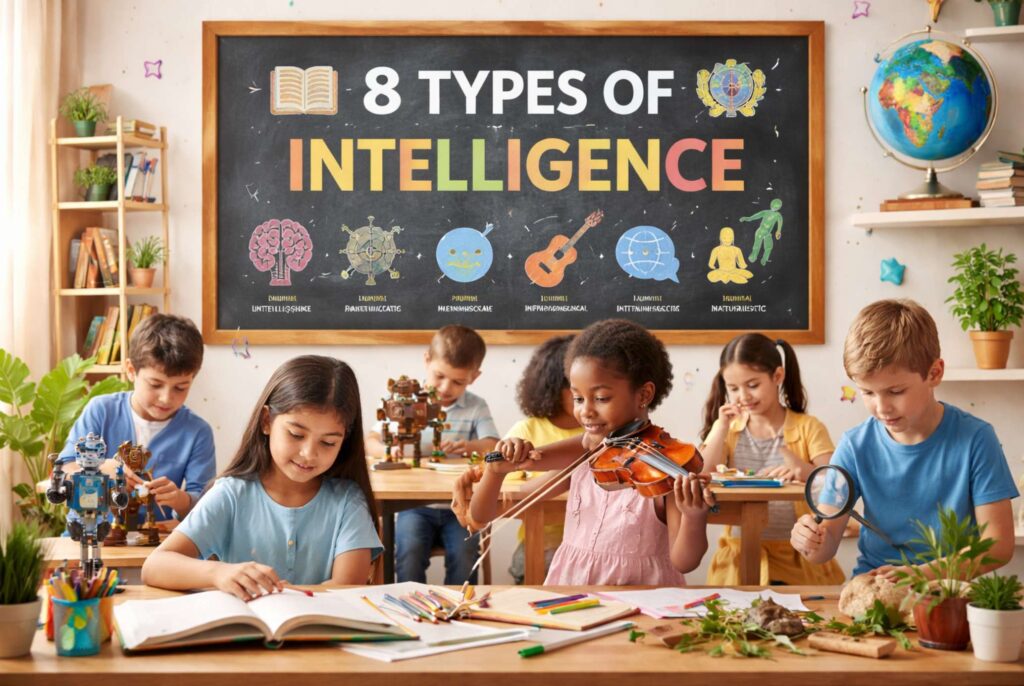
Portfolio 8 Types of Intelligence: Why Every Child Learns Differently Understanding Gardner’s Multiple Intelligence theory helps identify how children learn differently and supports better academic choices, learning methods, and career guidance. Services Multiple Intelligence Assessment Topic/Focus Understanding Children’s Learning Styles Author Dr. Chetan Kapadnis Not Every Child Learns the Same Way Modern education often assumes that all students learn in similar ways and should perform equally in subjects like mathematics, language, and science. However, many children who struggle academically are not less intelligent—they simply think and learn differently. Traditional schooling systems tend to measure only a narrow set of abilities, which may overlook many other forms of intelligence that children naturally possess. Psychologist Howard Gardner introduced the concept of Multiple Intelligence to explain that intelligence is not a single ability but a combination of different strengths. Some children understand concepts better through music, movement, visuals, or social interaction rather than textbooks or lectures. Recognizing these differences helps parents and educators create learning experiences that align with a child’s natural strengths, making education more engaging, effective, and meaningful. What is Multiple Intelligence Theory? Multiple Intelligence Theory was proposed by psychologist Howard Gardner in 1983. According to this theory, intelligence is not limited to IQ scores or academic performance. Instead, human intelligence consists of several different types that influence how individuals think, learn, and solve problems. Gardner originally identified eight different types of intelligence, each representing a unique way people understand the world. Some individuals excel in logical reasoning or language, while others demonstrate strengths in music, visual thinking, interpersonal relationships, or physical movement. Recognizing these intelligence types helps educators and parents support diverse learning styles and talents among children. The Eight Types of Intelligence Howard Gardner identified eight distinct forms of intelligence that describe different ways people process information and interact with the world. These include linguistic, logical-mathematical, spatial, musical, bodily-kinesthetic, interpersonal, intrapersonal, and naturalistic intelligence. Every child possesses a unique combination of these abilities, which influences how they learn and express their potential. For example, a child with strong linguistic intelligence may enjoy reading and storytelling, while a child with bodily-kinesthetic intelligence may learn best through movement, sports, or hands-on activities. Understanding these patterns helps teachers and parents adopt suitable learning strategies and career guidance approaches that match the child’s strengths rather than forcing a single academic path. Schools Focus Linguistic Logical Skills 0 % Linguistic Intelligence Logical Intelligence Spatial Intelligence Musical Intelligence Bodily Intelligence Naturalistic Intelligence Read our latest insights & blogs All Posts Elegant Portfolio How to Choose the Right Stream After 10th Standard PortfolioDr. Chetan Kapadnis Understanding Multiple Intelligence in Children PortfolioDr. Chetan Kapadnis How Psychometric Tests Help Students Choose Right Career PortfolioDr. Chetan Kapadnis Subscribe Newsletter
DMIT Basics: How Fingerprints Reveal Learning Styles
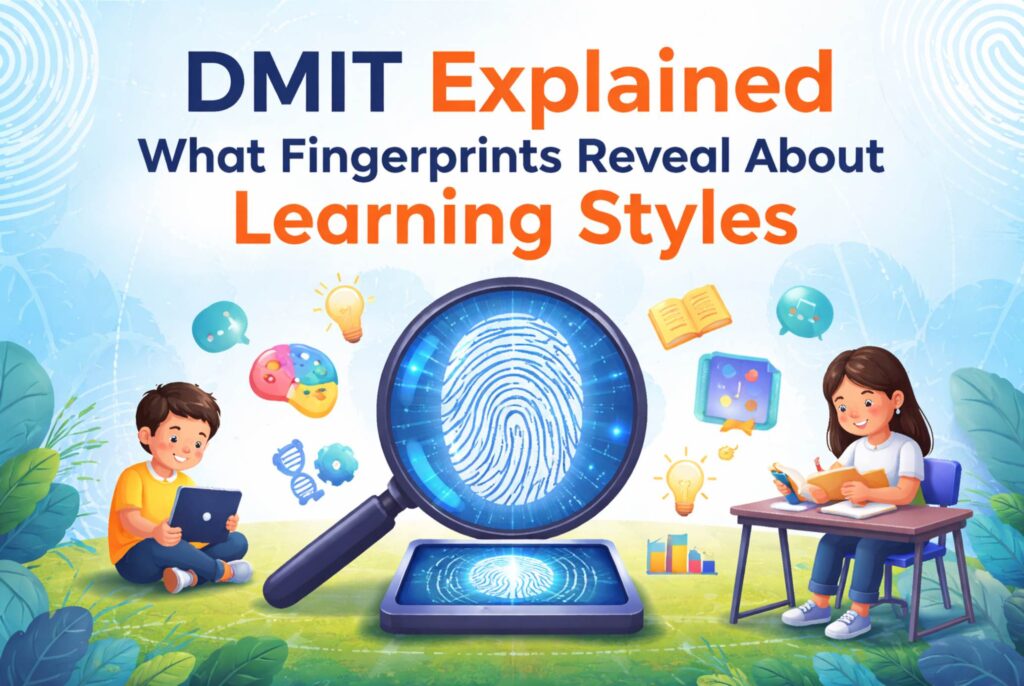
Portfolio DMIT Basics: How Fingerprints Reveal Learning Styles Understand how fingerprint patterns relate to brain development and learning preferences, and how DMIT helps identify individual cognitive strengths. Services DMIT Learning Insights Topic/Focus Fingerprint Based Learning Analysis Author Dr. Chetan Kapadnis Your Fingerprints May Reveal How You Learn Every individual is born with unique fingerprints that remain unchanged throughout life. Beyond identification, researchers have long studied the patterns of fingerprints and their connection with human brain development. Dermatoglyphics, the scientific study of these patterns, suggests that fingerprints form during early fetal development along with the brain and nervous system. Because both fingerprints and the brain develop simultaneously during pregnancy, some researchers believe fingerprint patterns may reflect aspects of neurological development. Dermatoglyphics Multiple Intelligence Test (DMIT) is based on this idea. It attempts to analyze fingerprint patterns to understand possible learning styles, cognitive tendencies, and natural abilities in children and adults. What Is Dermatoglyphics? Dermatoglyphics is the scientific study of the ridge patterns present on fingers, palms, and soles. These patterns begin forming between the 13th and 19th week of fetal development and remain permanent throughout life, making them useful for identification and scientific study. Scientists have used dermatoglyphics in fields like genetics, anthropology, and medical research. By examining ridge patterns such as loops, whorls, and arches, researchers can explore relationships between biological development and certain physical or neurological traits. How DMIT Connects Fingerprints and Learning The Dermatoglyphics Multiple Intelligence Test (DMIT) is based on the belief that fingerprint patterns reflect underlying brain development. Since fingerprints and the nervous system develop at the same stage during pregnancy, proponents of DMIT suggest that ridge patterns may provide clues about cognitive tendencies and learning preferences. Using fingerprint scans, DMIT reports attempt to identify potential strengths related to multiple intelligences such as logical thinking, creativity, communication, or interpersonal skills. The idea is not to label abilities but to provide insights that may help parents, educators, and individuals understand preferred learning styles and support more personalized education approaches. Loop Patterns – Most common fingerprint type globally 0 % Cognitive Strengths Language Skills Brain Dominance Talent Areas Personality Traits Intelligence Patterns Read our latest insights & blogs All Posts Elegant Portfolio How to Choose the Right Stream After 10th Standard PortfolioDr. Chetan Kapadnis Understanding Multiple Intelligence in Children PortfolioDr. Chetan Kapadnis How Psychometric Tests Help Students Choose Right Career PortfolioDr. Chetan Kapadnis Subscribe Newsletter
Science, Commerce, or Arts: Choosing Right Stream After 10th
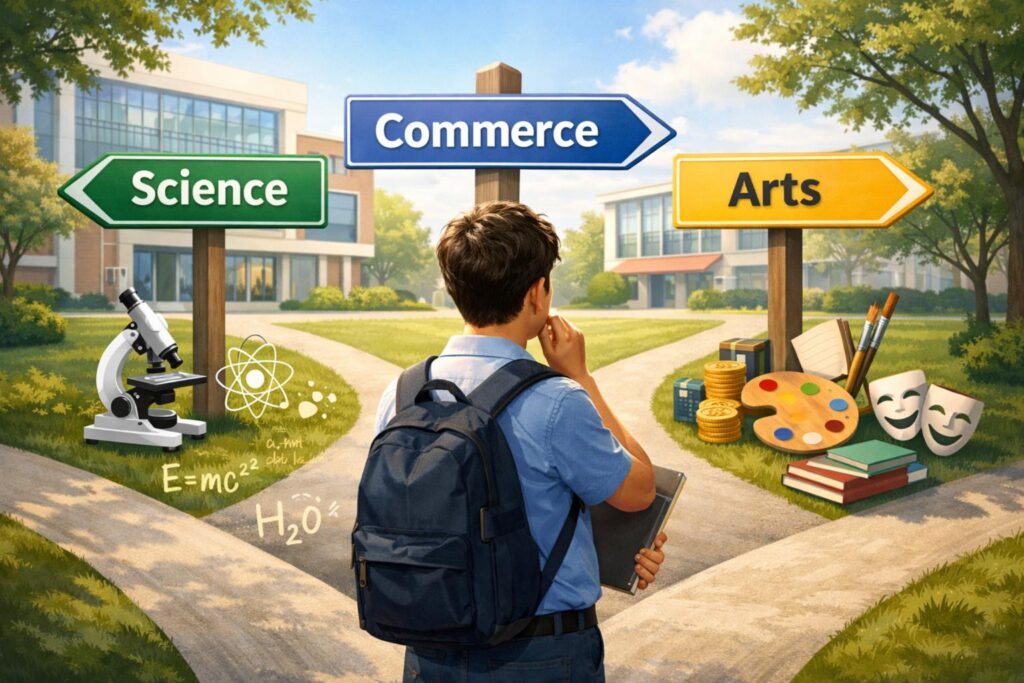
Portfolio Science, Commerce, or Arts: Choosing Right Stream After 10th In India, over 1.5 crore students appear for Class 10 annually; choosing the right stream shapes future careers (MHRD). Services Stream Selection Guidance Topic/Focus Choosing Right Academic Stream Author Dr. Chetan Kapadnis A Decision That Shapes the Future Every year, millions of students in India reach a turning point after completing Class 10. According to the Ministry of Education, more than 1.5 crore students appear for the Class 10 board examinations annually. Soon after results, they must select an academic stream—Science, Commerce, or Arts. While it may appear like a simple academic decision, it often influences higher education paths and career opportunities. However, many students choose streams based on marks, peer influence, or parental expectations rather than their true abilities and interests. Research by the OECD indicates that students who align education choices with their strengths are significantly more likely to remain engaged and perform better academically. Understanding personal aptitude and interests helps students make informed decisions instead of following common assumptions about “popular” streams. Why Stream Selection Matters? Choosing the right academic stream after Class 10 determines the subjects students study for the next two years and often influences their higher education choices. According to the National Education Policy (2020) discussions, early academic choices can impact long-term career trajectories. When students select streams aligned with their aptitude and interests, they tend to show higher academic engagement and confidence. Studies from UNESCO education reports highlight that students performing in areas aligned with their strengths demonstrate improved learning outcomes and career satisfaction. Understanding Strengths Before Choosing Many students select Science, Commerce, or Arts based on marks alone. While marks reflect academic performance, they do not always reveal natural strengths or interests. According to career development research from the National Career Development Association, aligning career choices with aptitude significantly improves long-term professional satisfaction. A better approach is to evaluate three key aspects: aptitude, interest, and personality. Aptitude shows natural abilities in areas like logical reasoning, numerical ability, or creativity. Interests indicate what subjects or activities students enjoy learning about. Personality traits influence working styles and career preferences. Tools such as psychometric assessments help students objectively understand these factors, enabling them to choose streams confidently instead of relying solely on assumptions. of students in India report confusion about career choices after Class 10 and 12 0 % Aptitude Interests Career Goals Personality Fit Academic Strengths Guidance Support Read our latest insights & blogs All Posts Elegant Portfolio How to Choose the Right Stream After 10th Standard PortfolioDr. Chetan Kapadnis Understanding Multiple Intelligence in Children PortfolioDr. Chetan Kapadnis How Psychometric Tests Help Students Choose Right Career PortfolioDr. Chetan Kapadnis Subscribe Newsletter
Why Students Today Need Career Counselling

Portfolio Why Students Today Need Career Counselling Over 93% of students know fewer than 10 careers despite 250+ options, making structured career counselling increasingly important today. Services Career Guidance Insights Topic/Focus Importance of Career Counselling Author Dr. Chetan Kapadnis Too Many Choices, Too Little Direction Today’s students are growing up in a world filled with thousands of career possibilities across technology, design, business, research, and emerging industries. However, awareness of these opportunities remains surprisingly low. Studies show that 93% of students are familiar with only about 7–10 career options, even though more than 250 career paths exist today. This gap between opportunities and awareness creates confusion for students and parents. As education systems evolve and industries change rapidly, traditional career advice based on limited knowledge is no longer sufficient. Structured career counselling helps students understand their strengths, interests, and abilities, enabling them to make more informed decisions and reduce uncertainty about their future. Changing Career Landscape The education and employment landscape has transformed dramatically in the last decade. Rapid technological advancement, globalization, and the rise of digital platforms have significantly reshaped how careers are created and how skills are valued in the workforce. New industries such as artificial intelligence, data science, digital design, cybersecurity, and sustainability-related careers have expanded career possibilities far beyond traditional professions like medicine, engineering, and law. As industries evolve quickly, many emerging roles did not even exist a decade ago, making career planning more complex than ever before. Students today must not only choose a field of study but also prepare for a dynamic job market that continuously introduces new opportunities and skill requirements. However, research indicates that 39% of teenagers are unsure about their career path, highlighting the growing confusion students face when planning their future. This uncertainty often arises because students receive limited exposure to the wide range of modern career opportunities available today. Many rely on conventional advice from family, peers, or societal expectations rather than structured guidance based on their abilities and interests. Without proper awareness and support, students may select academic streams or career paths that do not align with their strengths. As a result, many young people experience anxiety, indecision, and pressure while making important educational choices during their school years. Why Career Counselling Matters Today Students today face a complex environment where career decisions must consider skills, interests, emerging industries, and long-term opportunities. Without structured guidance, many students rely on family opinions or popular trends rather than scientific assessment of their abilities. Studies show that only about 10% of students in India receive professional career guidance, leaving most to navigate critical decisions without expert support. Career counselling introduces a systematic approach to decision-making. Through tools such as psychometric assessments, aptitude analysis, and interest mapping, students gain clarity about suitable career directions. This helps them choose appropriate academic streams, reduces stress caused by uncertainty, and enables better alignment between their strengths and future career opportunities. Students aware of only 7–10 career options 0 % Career Awareness Aptitude Mapping Interest Analysis Career Clarity Stream Selection Decision Support Read our latest insights & blogs All Posts Elegant Portfolio How to Choose the Right Stream After 10th Standard PortfolioDr. Chetan Kapadnis Understanding Multiple Intelligence in Children PortfolioDr. Chetan Kapadnis How Psychometric Tests Help Students Choose Right Career PortfolioDr. Chetan Kapadnis Subscribe Newsletter
Understanding Children’s Unique Learning Styles
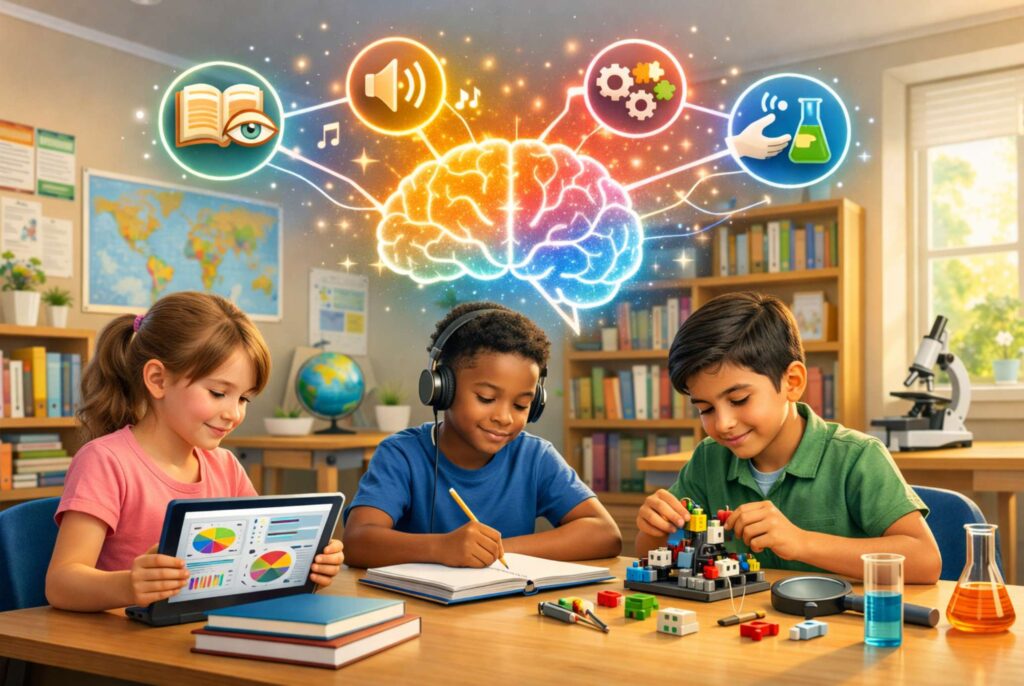
Portfolio Understanding Children’s Unique Learning Styles Studies show 65% of people are visual learners; identifying learning styles helps improve academic performance, engagement, and knowledge retention. Services Learning Style Insights Topic/Focus Understanding children’s learning preferences Author Dr. Chetan Kapadnis Why Some Children Study Hard but Still Struggle Many parents notice a puzzling situation: a child spends hours studying but still finds it difficult to perform well in exams. Research from the National Training Laboratories suggests that learners retain only 10% of what they read but nearly 75% of what they practice. This difference happens because every child processes information differently. Some students learn best by seeing diagrams, others by listening to explanations, and some by doing activities or experiments. When teaching methods do not match a child’s natural learning preference, learning becomes frustrating. Understanding how children absorb information helps teachers and parents support them better and improve both confidence and academic performance. What Are Learning Styles? Learning styles describe the preferred ways individuals process, understand, and remember information. Educational psychologists widely categorize them into types such as visual, auditory, kinesthetic, and logical learning. According to educational research, adapting teaching methods to these preferences can significantly improve engagement and comprehension. For example, visual learners understand concepts better through charts, diagrams, and videos, while auditory learners benefit from lectures, discussions, and storytelling. Kinesthetic learners grasp ideas through hands-on activities and experiments, highlighting how brain processing preferences shape learning effectiveness. Connection Between Learning Styles and Multiple Intelligence Learning styles are closely connected to Howard Gardner’s Multiple Intelligence Theory, which proposes that intelligence is not a single ability but a combination of different strengths. Gardner identified eight types of intelligence, including linguistic, logical-mathematical, spatial, musical, interpersonal, and kinesthetic abilities. Recognizing these strengths helps educators design teaching strategies that support diverse learners. When teaching approaches align with a student’s natural strengths, learning becomes easier and more enjoyable. For example, a child with strong visual-spatial intelligence may understand concepts through diagrams and mind maps, while someone with bodily-kinesthetic intelligence learns better through experiments or physical activities. Studies indicate that active learning strategies can improve retention rates by up to 75%, emphasizing the importance of adapting teaching methods. of Learners Prefer Visual Learning Methods 0 % Visual Learning Auditory Learning Kinesthetic Learning Logical Thinking Brain Preferences Adaptive Teaching Read our latest insights & blogs All Posts Elegant Portfolio How to Choose the Right Stream After 10th Standard PortfolioDr. Chetan Kapadnis Understanding Multiple Intelligence in Children PortfolioDr. Chetan Kapadnis How Psychometric Tests Help Students Choose Right Career PortfolioDr. Chetan Kapadnis Subscribe Newsletter